


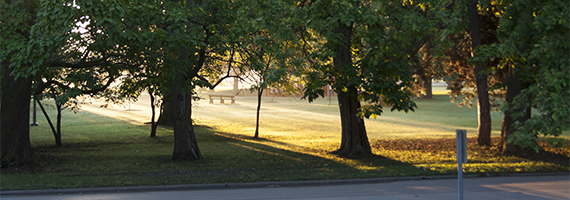
In my second year of college, I was taking my first painting class. What came up during the class was the assertion that warm light produces cool shadows and cool light produces warm shadows. The textbook even gave a real world example of this by showing an outdoor picture on a sunny day. The image above shows this effect as you can see the warm sunlight streaming through the park creating cool shadows.
One such instance of the claim regarding the color of shadow comes from John Ruskin’s 1834 book, On the Old Road. “It is a well-known optical fact that the color of shadow is complemental to that of light: and that therefore, in general terms, warm light has cool shadow, and cool light hot shadow.” Even in more recent books, such as Douglas R. Graves, Figure Painting in Oil, this is repeated again. “In nature warm and cool colors are often found in juxtaposition. Sunlight— especially the hot light of early morning or late afternoon— is warm, while the deep shadows that objects create in such light are cool.” Both of these quotes are here to illustrate that it’s being actively taught that warm and light colors produce shadows which are the opposite in temperature of the light source.
Just prior to the painting class, I took a class in color theory. Color theory is too heavy of a topic to discuss in great detail, but as it applies to this post I can give you a quick explanation of how light and color function. We see color only when light exists. A space or area devoid of any light will not allow us to see any color as it is the light illuminating a surface that permits our eyes to see color. A cast shadow is the result from the absence of light where an object is obscuring the light source. The color of a light source will also determine the color of an object. A white piece of paper will be blue under a blue light while something yellow will appear green under the same light as yellow and blue form green as a secondary color.
In the painting class, we had to paint a subject twice. Once using a cool light source and a second time using a warm light source. In the warm light source image, I painted a warm shadow and in the cool light source image I painted a cool shadow according to the light source I was using for both instances. When I turned in the assignment, I was told by my professor that my painting was wrong because of the warm/cool light and shadow principle the book spoke of. As you can imagine this was quite confusing as I didn’t see a cool shadow with the warm light nor a warm shadow with the cool light. I painted each subject exactly as I observed it with how it lit it in my office.
That interaction with the professor confused me for quite a while after the class ended. I knew what I saw while the professor didn’t, but thinking about the topic it didn’t make any sense how a warm light could have a cool shadow. Not in the sense that I didn’t understand how the color of a light source will change the appearance of anything illuminated by the light, but how a surface behind that object would have a shadow that opposes the available light. As I mentioned earlier, a yellow piece of paper illuminated by a blue light will appear green. it doesn’t make sense that if the paper is behind an object being lit by a blue light that the paper would appear warmer in the shadow. Seeing as how Google is my friend, I decided to do some research recently. I found countless numbers of websites, articles and YouTube videos dedicated to warm and cool shadows being the opposite color of the light source. Then I ran across the painting website Painting Videos by Daniel Edmondson where he addresses warm and cool shadows.
You can go there to read his findings, as the link goes directly to his article about light and shadow temperature, but to summarize what he found; the reason why warm light appears to create cool shadows is because of secondary lighting. I setup my own experiment in After Effects by creating a 3D scene that used a surface plane, a box, warm and cool ambient lights, warm and cool spotlights and a single white only spotlight. The first image is just of the white only spotlight. You can see that the ground plane, the box and the shadow all have neutral coloring as none of the elements have a defined hue. In the file, the surface plane is 10% gray and the box is 15% grey. The use of very light greys prevents the surface and box from being blown out by the lights if they were both 100% white, it allows them to be easily identified and they only absorb a small amount of light.

Image 1
In the second image, a warm spotlight is illuminating the subject and has a cool shadow. The warm light falls in the range of yellow/warm colors and the shadow falls in the range of green/cool colors.
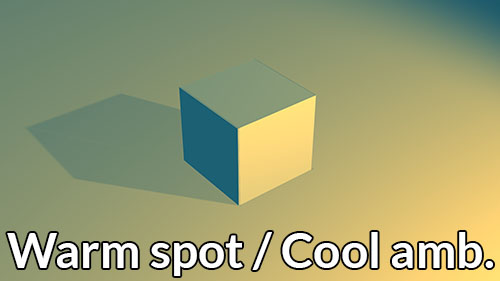
Image 2
In the third image, a cool spotlight is illuminating the subject and has a warm shadow. The cool light falls in the range of blue/cool colors and the shadow falls in the range of yellow/warm colors.
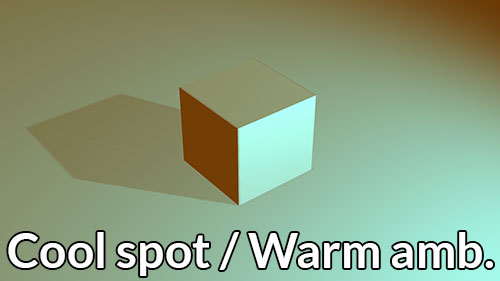
Image 3
Despite these images apparently contradicting everything I’ve been speaking about up until now, the two previous images aren’t lit by only one light. A spotlight and an ambient light are used in both scenes. The bottom of each image states the temperature of the spot light and the temperature of an ambient light source. The reason for lighting the scene with both a spotlight and an ambient light is that this represents a more real-world lighting scenario than just a single light source. On a sunny day, the sun and the ambient light from the sky are illuminating you. Even though it’s the sun that has the primary presence, the ambient light from the sky is also lighting everything as well. The next two images show how this scene would look with only the use of the spotlights.
In image four, we see the scene lit by the same warm spotlight as in image two but without the additional cool ambient light. In this image, the entire scene is warm due to the single light including the shadow behind the cube.

Image 4
In image five, we see the scene lit by the same cool spotlight as in image three but without the additional warm ambient light. Again, the scene only has cool coloring due to the cool light and again the shadow corresponds to the sole light source.
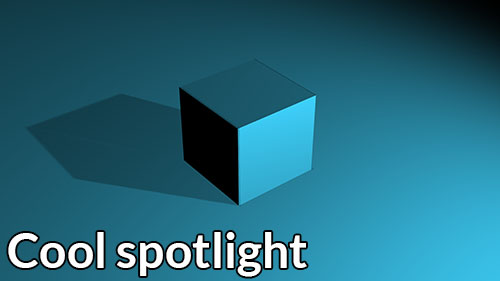
Image 5
If you’re wondering why the fourth and fifth images are very orange and blue, it’s due to the lack of the ambient lights. The color of these two spotlights weren’t changed from images one and two. The apparent increase in the color of both images is just from the ambient light not adding additional color to the scene. Thinking about the yellow paper and blue light, if you just lit the paper with a white light it would appear yellow. But if you lit the paper with a light that was slightly blue it would shift the visual color of the paper towards green.
What this experiment shows is that warm light does not create cool shadows and that cool light does not create warm shadows. The belief that this is true is simply due to a secondary light source also illuminating a scene thus creating the temperature of the shadow that you see. If the secondary light source did not exist then the shadow would fall in the same temperature range as the primary light source.